
Lord, in your mercy…
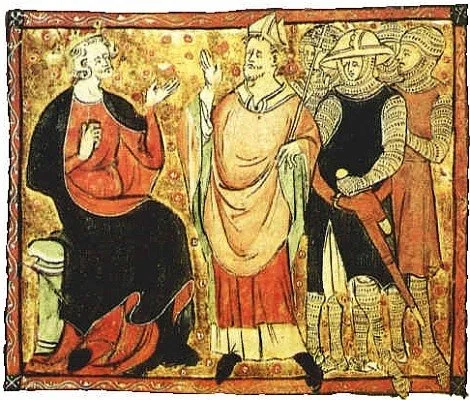
14th-century depiction of King Henry II of England with Archbishop of Canterbury Thomas Becket
Wednesday, January 14, 2026
written by Rev. Dr. Mike Hegeman
Just a couple of weeks ago, on December 29, parts of the worldwide Christian church remembered the death of Thomas à Becket. Have you heard of him? You might not have. He died 856 years ago.
Why should the church remember one guy, from that long ago, when so many have died since then?
Well, Thomas was murdered.
Okay, so lots of folks have been murdered.
Yes, but Thomas was a priest.
Okay, so the pool gets smaller, but many priests have been murdered. Well, I’ll stop beating around the bush. Thomas was the Archbishop of Canterbury at the time he was murdered in 1170 by four knights working under the king’s authority.
Well, that is concerning.
I first learned about Thomas while at seminary, not in a class, but through a dramatized version of his life, called Murder in the Cathedral by T. S. Eliot (1935). Every year, the seminary put on a play, and for a number of years, I got to write music for these productions, including this one.
In 1170, Thomas was the head of the Catholic Church in England, a very powerful position. He had been a long-time friend of the King of England, Richard II, who had put Thomas in several powerful governmental positions, but their relations had begun to sour since Thomas became archbishop in 1162, because Thomas had begun to challenge the king’s role in matters of the church.
So, then who murdered Thomas?
Well, it’s too easy to say that the king murdered him or had him murdered. The story is complicated. Because these two historic figures represented far more than just themselves, standing in for two juggernauts of power, the Church and the State, their words and actions took on historic impact. Thomas, now that he held the highest ecclesiastical power in the land, had begun to express a certain independence for the church from the control of the king. Thomas put a huge strain on his former friendship with Richard when he asserted that certain matters of the faith [that is, the Church] were free from the power of the monarchy. [The details of this story are actually far more nuanced and complicated.] In the end, it isn’t clear if Henry, enraged by what felt like betrayal, ordered Thomas’ murder or had inspired others to enact the king’s intention, in imploring, “Will no one rid me of this meddlesome priest?!”
The thing is, that a gang of knights, state-sponsored thugs, after hearing the king’s words, broke into the cathedral of Canterbury, and murdered Thomas as he was helping to lead vespers, during Christmastide. The details of his murder are quite gruesome.
The Christian church remembers this story and this man Thomas, in part to say, “We stand with those who have stood up for faith over and against the abuses of secular power.” Struggles between Church and State have continued throughout the last 800 years.
Closer to our own time, in 1980, another archbishop was murdered by state-inspired violence, this time in El Salvador. Oscar Romero, who spoke out against social injustice and violence amid the escalating conflict between the military government and left-wing insurgents, was shot by an assassin while celebrating mass, a couple days after he had delivered a sermon in which he had called on Salvadoran soldiers, as Christians, to obey God's higher order and to stop carrying out the government's repression and violations of basic human rights. Oscar was killed in a small chapel connected to the hospital, where cancer patients went to pray for God’s healing and comfort. No one was ever convicted for the crime. Many more priests and nuns were killed in El Salvador during this time.
I think of Thomas and Oscar every time I step into our chapel or sanctuary, especially when approaching the Lord’s Table. There are many more to add to the list of the faithful who are martyred while working for what is just and good. Their number grows day by day.
Kyrie eleison, Christe eleison, Kyrie eleison. Lord, have mercy on us all.