
Learning to Disagree—Together
Wednesday, September 23, 2026
written by Rev. Erik Khoobyarian
Disagreement is not new. But many of us sense that something about it has changed. Our disagreements seem quicker to become judgments, our judgments quicker to become divisions. We are tempted to avoid difficult conversations altogether—or to enter them determined to win.
The church should be able to offer another way.
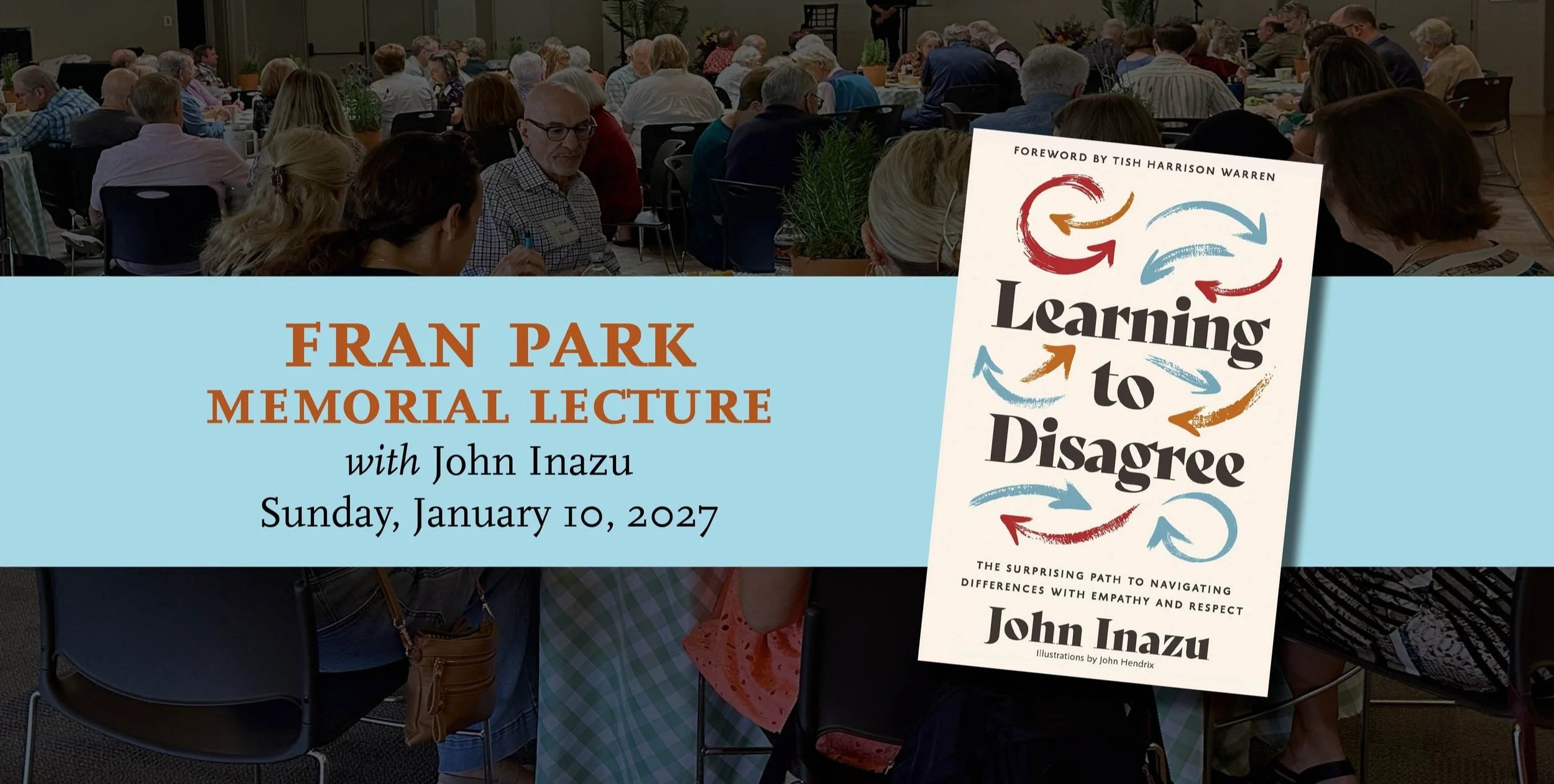
That is why I hope many of you will join me in reading John Inazu’s Learning to Disagree: The Surprising Path to Navigating Differences with Empathy and Respect. Inazu will be with us on Sunday, January 10, 2027, to present the Fran Park Memorial Lecture, and reading his book beforehand will help us prepare for a richer conversation during his visit.
John Inazu is the Sally D. Danforth Distinguished Professor of Law and Religion at Washington University in St. Louis. His work explores religious freedom, free speech, and the practices that help people live together across deep and enduring differences. He is a serious legal scholar, but Learning to Disagree is neither a textbook nor an abstract argument. It is personal, engaging, frequently funny, and grounded in the ordinary places where disagreement happens: classrooms, workplaces, churches, friendships, and families.
The book asks questions that feel especially urgent now: How do we learn empathy? What happens when we cannot compromise? Can we have difficult conversations? Where is the line between wrong and evil? Is forgiveness possible? Can we remain friends?
Inazu does not ask us to pretend that our differences are unimportant. He does not suggest that every conflict can be resolved if we are simply nicer to one another. Nor does he ask us to surrender our convictions. Instead, he invites us to develop the habits that allow us to hold convictions with both confidence and humility—to speak honestly, listen carefully, extend empathy, and continue seeing a person where we might otherwise see only a position or a problem.
That is deeply relevant to our life together as Christians.
Learning to disagree is not merely a useful strategy for surviving a polarized culture. It is part of learning to love our neighbors. It requires patience when a conversation does not go as we hoped, curiosity about experiences different from our own, and the humility to admit that our understanding may be incomplete. It also calls us to resist the easy habit of treating those with whom we disagree as enemies.
None of this is easy. That is precisely why these practices are best learned in community.
I hope you will read Learning to Disagree, either individually or with others. Invite a few friends to read alongside you. Bring it to an existing small group, form a temporary book group, or ask someone whose perspective differs from yours to discuss it over coffee. The book’s stories and questions lend themselves especially well to conversation.
If your small group is reading the book, please email Kelly McGinn. We would like to know who is participating so that we can stay connected with our readers and share information about the opportunities surrounding Inazu’s visit.
We are planning special events for those who have read the book, including a program on Saturday, January 9. Inazu will then present the Fran Park Memorial Lecture on Sunday, January 10. More details about these gatherings will follow.
If you would like an introduction before beginning the book, I recommend this video conversation with John Inazu, see below:
You can also learn more about Inazu and his work on his website.
My hope is not that we will all finish this book agreeing with one another. That would miss the point. My hope is that we will become a community better equipped to face real differences without fear, contempt, or withdrawal—a community in which truth and love belong together, difficult questions can be asked honestly, and relationships can endure even when agreement remains out of reach.
Please read Learning to Disagree. Read it alone if that is what your schedule allows. Better yet, read it with someone else. Then come ready in January to continue the conversation together.